Originally founded as the Houston Oilers in 1960, the team now known as the Tennessee Titans was one of the AFL’s charter members and quickly found success behind innovative coaching, electric offenses, and a devoted fanbase.
After the initial highs, the franchise struggled to find consistent success in both the AFL and NFL. After decades in Houston, highlighted by the Warren Moon era and the explosive run-and-shoot offense, the franchise relocated to Tennessee in the late 1990s and officially became the Titans in 1999.
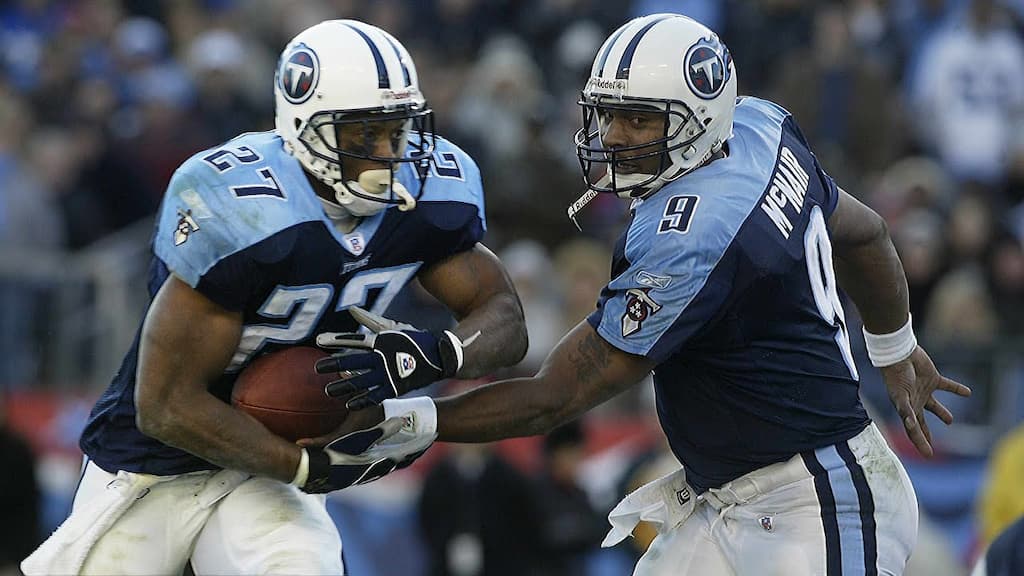
The rebrand coincided with a breakthrough moment in team history. Powered by stars like Steve McNair, Eddie George, and rookie pass-rusher Javon Kearse, Tennessee surged to Super Bowl XXXIV, falling short against the St. Louis Rams in a finish now etched into NFL lore. That run cemented a new identity built on physicality, toughness, and a passionate Nashville fanbase.
Over the years, the Titans carved out their place as one of the league’s most resilient organizations. Derrick Henry dominated the late 2010s and early 2020s with record-breaking rushing performances, while Mike Vrabel guided the team to multiple playoff appearances and an AFC Championship Game before his tenure ended in 2023.
Where Do the Tennessee Titans Play?
The Tennessee Titans play at Nissan Stadium in Nashville, Tennessee, located along the Cumberland River near downtown. Opened in 1999, the venue holds over 69,000 fans and is known for its lively atmosphere on game days.
Construction is also underway on a new state-of-the-art stadium, which will also carry the Nissan Stadium name. Set to open in 2027, it will be the franchise’s new home and will serve as a major upgrade to the current stadium. It promises to be a new hub for excitement and entertainment in Nashville.
History of the Tennessee Titans
From the Oilers to the Titans, the franchise has showcased elite talent, iconic moments, and generational leaders. The franchise began as the Houston Oilers in 1960 and quickly became one of the early AFL’s premier teams.
Led by head coach Bum Phillips in the 1970s, the Oilers featured the legendary Earl Campbell and made back-to-back AFC Championship Game appearances in the 1978 and 1979 seasons. They fell to the Pittsburgh Steelers both years but cemented their status as a top team in the AFC.
After the Warren Moon era in the late 1980s and 1990s, the team underwent major change and ultimately relocated to Tennessee in 1997. They played as the Tennessee Oilers for two seasons before rebranding as the Titans in 1999, a year that produced immediate magic. Tennessee’s postseason featured the unforgettable Music City Miracle and culminated in a Super Bowl appearance decided by mere inches.
The 2000s remained competitive under Jeff Fisher, with consistent playoff contention and defining defensive play. The late 2010s ushered in a new surge behind Derrick Henry’s dominant rushing seasons and Mike Vrabel’s aggressive coaching philosophy.
Tennessee reached the AFC Championship Game in the 2019 season, losing to the Kansas City Chiefs. More success followed before Vrabel’s departure after a challenging 2023 season. Henry’s era also closed that same offseason, marking the end of one of the franchise’s most memorable chapters.
Interesting Tennessee Titans Facts & Franchise Milestones
- Founded in 1960 as the Houston Oilers
- Two-time AFL champions (1960, 1961)
- Relocated to Tennessee in 1997; became the Titans in 1999
- Reached Super Bowl XXXIV, losing to the St. Louis Rams
- Home of the Music City Miracle in the 1999 playoffs
- Derrick Henry and Chris Johnson both rushed for 2,000 yards in a season with the Titans
- New stadium project underway to shape the future of Titans football
Notable Tennessee Titans Players & Coaches
Notable Players
Earl Campbell, Running Back (1978-1984)
Campbell was one of the most physically dominant runners the sport has ever seen, powering through defenders with brute strength and balance. He won NFL MVP in 1979, led the league in rushing three straight seasons, and became the face of the Oilers’ rise under Phillips. Campbell’s punishing style and highlight runs remain defining images.
Bruce Matthews, Offensive Line (1983–2001)
A 14-time Pro Bowler who anchored the offensive line for nearly 20 years, Matthews is the standard-bearer for versatility and longevity in franchise history.
Warren Moon, Quarterback (1984–1993)
A Hall of Famer and one of the most prolific passers of his era, Moon led high-powered Oilers offenses and changed perceptions of quarterback play with his elite arm talent.
Steve McNair, Quarterback (1995–2005)
The heart of the Titans for a decade, Steve McNair led the team to its lone Super Bowl appearance and shared the 2003 NFL MVP award. His leadership, toughness, and clutch play in notable wins for Tennessee remain defining traits of Titans football.
Frank Wycheck, Tight End (1995–2003)
A reliable receiving option and emotional spark, Wycheck played a major role in the Music City Miracle and was a favorite target for McNair throughout the early Titans era.
Eddie George, Running Back (1996–2003)
A workhorse back and cornerstone of the late-90s offense, George rushed for over 10,000 yards and helped shape the franchise’s physical identity during its transition to Tennessee.
Javon Kearse, Defensive End (1999–2003, 2008–2009)
“The Freak” captured national attention as a rookie with 14.5 sacks and brought a new level of speed to the edge. He was a key force in the Titans’ 1999 Super Bowl run.
Chris Johnson, Running Back (2008–2013)
One of the NFL’s fastest-ever players, Chris Johnson became known as “CJ2K” after his 2,006-yard rushing season in 2009. Explosive and electric, he was a highlight machine during his prime in Nashville.
Derrick Henry, Running Back (2016–2023)
A modern legend, Henry’s size-speed combination overwhelmed defenders. While with Tennessee, he won two rushing titles, was named 2020 Offensive Player of the Year, and helped raise expectations for the Titans under Vrabel.
Notable Coaches
Bum Phillips (1975–1980)
Phillips revived the Oilers with physical football and hard-nosed defense, leading them to consecutive AFC Championship appearances. His partnership with Earl Campbell became franchise folklore.
Jerry Glanville (1986–1989)
Known for swagger and aggressive defensive schemes, Glanville helped push Houston back into competition and laid groundwork for later success.
Jack Pardee (1990–1994)
Pardee, a key figure in football in Houston in the 1980s and 1990s, earned notoriety for high-powered offenses. With the Oilers, his first four teams reached the playoffs, and the 1991 and 1993 teams won the AFC Central.
Jeff Fisher (1994–2010)
Fisher guided the franchise through relocation and into relevance in its early years as the Titans, leading Tennessee to Super Bowl XXXIV and multiple playoff runs. Defensive discipline and stability defined his long tenure.
Mike Vrabel (2018–2023)
Vrabel restored the Titans to consistent playoff contention and oversaw Derrick Henry’s peak era. He led Tennessee to the AFC Championship Game, three playoff appearances, and two AFC South titles.