Few NFL franchises combine long-term success, iconic players, and memorable championship moments the way the San Francisco 49ers do.
Founded in 1946 as part of the All-America Football Conference before entering the NFL in 1949, the 49ers grew from a regional program into one of football’s most influential teams. Their legacy is built on pioneering offensive innovation, standout quarterback play, and a culture of competing at the highest level.
The franchise’s rise began in the late 1970s and took shape through the 1980s under head coach Bill Walsh and quarterback Joe Montana. Their efficient West Coast offense became a league standard and helped secure multiple Super Bowl victories.
When Steve Young took over, the success continued with another Super Bowl and several strong postseason appearances, extending the team’s prominence well into the 1990s.
After periods of rebuilding, the 49ers returned to prominence under Jim Harbaugh in the early 2010s. Powered by a physical defense, productive ground game, and a talented roster, the Niners returned to the Super Bowl.
The most recent rise in San Francisco came under Kyle Shanahan, who helped steer the 49ers to Super Bowl appearances in the 2019 and 2021 seasons.
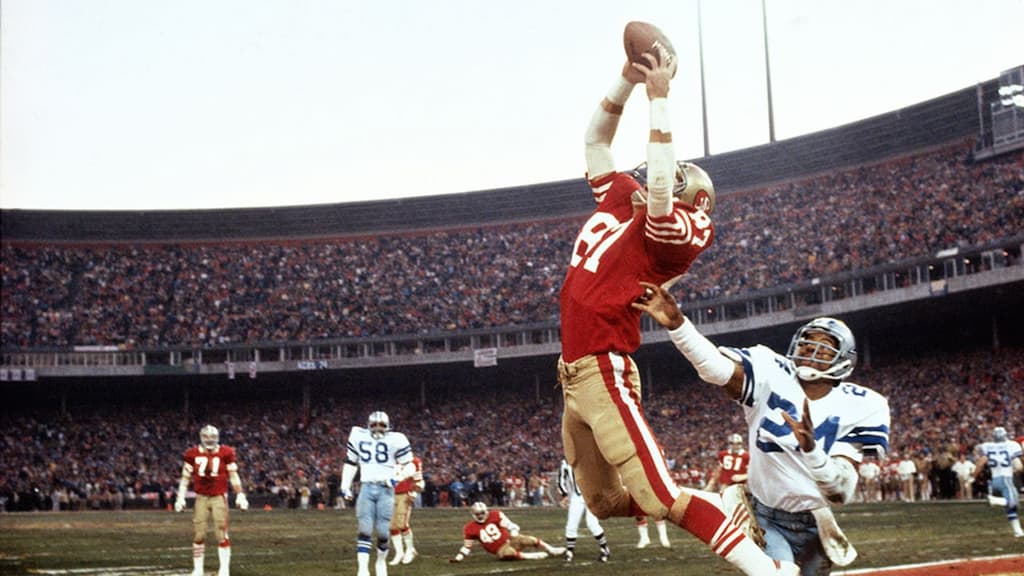
Historic moments remain closely tied to the identity of the 49ers, including “The Catch,” memorable playoff games, and championship performances that shaped expectations for future teams. San Francisco carries a reputation for strong drafting, player development, and evolving its schemes rather than relying solely on nostalgia.
Today, the franchise continue to field competitive rosters built around star players and a modern, adaptable coaching approach. The goal in San Francisco remains the same as it has been for decades: to compete for championships and maintain a standard set during the 49ers’ most successful periods.
Where Do the San Francisco 49ers Play?
The San Francisco 49ers play at Levi’s Stadium, located in Santa Clara, California. Known for warm weather games and a wide, open seating layout, Levi’s Stadium provides a bright, energetic backdrop for 49ers football.
Opened in 2014, the stadium offers a modern, high-capacity environment with over 68,000 seats, sustainable design features, and a reputation for hosting major events. It hosted Super Bowl 50 between the Denver Broncos and Carolina Panthers, and it will host Super Bowl LX as well.
Outside of football, Levi’s Stadium hosted has hosted major college football games, international soccer, major concerts, and even an NHL matchup. It will be one of the venues for the 2026 FIFA World Cup, with six matches set to take place there.
History of the San Francisco 49ers
The 49ers began play in 1946 and officially joined the NFL in 1949, quickly earning attention through talented backfields and competitive early rosters. The franchise’s early decades featured standout players like Y.A. Tittle and Hugh McElhenny, but it wasn’t until the late 1970s and 1980s that San Francisco became a dominant force.
Bill Walsh’s arrival in 1979 set the stage for a football revolution. With Joe Montana executing Walsh’s West Coast offense, the 49ers won Super Bowls XVI (vs. the Cincinnati Bengals), XIX (vs. the Miami Dolphins), and XXIII (vs. the Bengals).
After Walsh stepped down following the second win over the Bengals, defensive coordinator George Seifert took over and guided the 49ers to a repeat with a dominant Super Bowl XXIV win over the Broncos.
With four championships coming to San Francisco in nine seasons, the 49ers were the premier team of the 1980s. Legendary moments defined the era, including Dwight Clark’s game-winning catch against the Dallas Cowboys in the 1981 NFC Championship Game, now simply known as “The Catch.”
Steve Young later took the reins at quarterback, leading the team to a record-breaking victory over the San Diego Chargers in Super Bowl XXIX.
The 2000s brought rebuilding years, but San Francisco re-emerged behind coach Jim Harbaugh, star defenders like Patrick Willis and NaVorro Bowman, and dynamic playmakers including Frank Gore. A Super Bowl appearance in the 2012 season signaled the franchise’s return, though they fell to the Baltimore Ravens.
Under Kyle Shanahan, the 49ers built a new identity rooted in motion-heavy offense, versatile skill players, and strong trench play.
Today, the modern 49ers continue to chase the franchise’s sixth Lombardi Trophy. San Francisco stands as a team defined by strategic evolution, player development, and a sustained expectation of winning.
Interesting San Francisco 49ers Facts & Franchise Milestones
- Founded in 1946 and joined the NFL in 1949
- Five-time Super Bowl champions (1981, 1984, 1988, 1989, 1994)
- Innovators of the West Coast offense under Bill Walsh
- Home to Hall of Fame QBs Joe Montana and Steve Young
- Dwight Clark’s “The Catch” remains one of the most iconic plays in NFL history
- One of the league’s most successful postseason franchises
- Strong 21st-century resurgence under Kyle Shanahan
Notable San Francisco 49ers Players & Coaches
Notable Players
Joe Montana, Quarterback (1979–1992)
Montana became the defining figure of the 49ers dynasty, leading the team to four Super Bowl championships with elite accuracy, poise, and clutch brilliance. His connection with Jerry Rice helped produce one of the most unstoppable passing attacks the NFL has ever seen.
Ronnie Lott, Defensive Back (1981–1990)
A fierce hitter and emotional leader for the 49ers, Lott anchored the San Francisco secondary during the dynasty years. His versatility and fearless play established him as one of the greatest defensive backs in league history.
Roger Craig, Running Back (1983–1990)
Craig was one of the first true dual-threat running backs. He became the first NFL player to record 1,000 rushing and 1,000 receiving yards in a season. He played a key role in multiple championship runs and set the template for modern multi-purpose backs.
Jerry Rice, Wide Receiver (1985–2000)
Considered by many the greatest wide receiver of all time, Jerry Rice set records that remain untouched. His work ethic, route running, and production at championship level helped power three Super Bowl titles and shaped the future of modern passing offenses.
Steve Young, Quarterback (1987–1999)
Young took the reins from Montana and became a superstar in his own right. He won NFL MVP three times and threw a record six touchdown passes with a record six touchdown passes. His dual-threat style made him one of the most influential quarterbacks of the 1990s.
Frank Gore, Running Back (2005–2014)
Gore built a legacy on consistency, toughness, and longevity. In 10 seasons with the 49ers, Gore ran for 1,000 yards eight times, and he left San Francisco as the franchise’s all-time rushing leader.
Patrick Willis, Linebacker (2007–2014)
Willis dominated as one of the most complete linebackers of his generation. He was known for sideline-to-sideline speed and leadership in the heart of the defense.
Due to his early retirement, his peak was short, but it was also elite. He earned five first-team All-Pro selections and a spot on the league’s 2010s All-Decade team, despite playing only part of the decade.
George Kittle, Tight End (2017–present)
Kittle combines elite blocking with dynamic receiving ability, making him one of the most complete tight ends in the NFL. He is a cornerstone of the 49ers’ modern offense and has been a key player in their recent playoff runs.
Fred Warner, Linebacker (2018–present)
Warner has become the modern face of the 49ers defense with elite coverage ability, instincts, and leadership. He plays a pivotal role in San Francisco’s defensive identity and remains one of the NFL’s premier linebackers. A multi-time first-team All-Pro selection, Warner is on course for a bust in Canton.
Nick Bosa, Defensive End (2019–present)
A dominant pass rusher with explosive power and technique, Bosa quickly became one of the league’s most feared defenders. In addition to winning NFL Defensive Rookie of the Year (2019) and NFL Defensive Player of the Year (2021), Bosa has been named a Pro Bowler several times.
Notable Coaches
Bill Walsh (1979–1988)
Walsh transformed football with the West Coast offense, emphasizing timing, precision, and yards after catch. He guided San Francisco to three Super Bowl championships and established a coaching tree that influenced both the 49ers and the rest of the NFL.
George Seifert (1989–1996)
Seifert continued what Walsh built and maintained championship excellence, winning two Super Bowls of his own. Under his leadership, the 49ers remained a powerhouse, consistently finishing among the league’s best teams.
Jim Harbaugh (2011–2014)
Harbaugh revitalized the franchise with a tough, physical identity. He led the 49ers to three straight NFC Championship Game appearances and a Super Bowl appearance. His tenure reignited the fan base and set the stage for the roster core that followed.
Kyle Shanahan (2017–present)
Kyle Shanahan is the son of two-time Super Bowl-winning head coach Mike Shanahan. The elder Shanahan was the offensive coordinator for San Francisco’s record-setting Super Bowl XXIX squad. The younger Shanahan brought his own creativity and modern offensive innovation to San Francisco.
Championship contention is the annual expectation under Shanahan, who has led the 49ers to three NFC West titles, four NFC Championship Game appearances, and two Super Bowl berths.