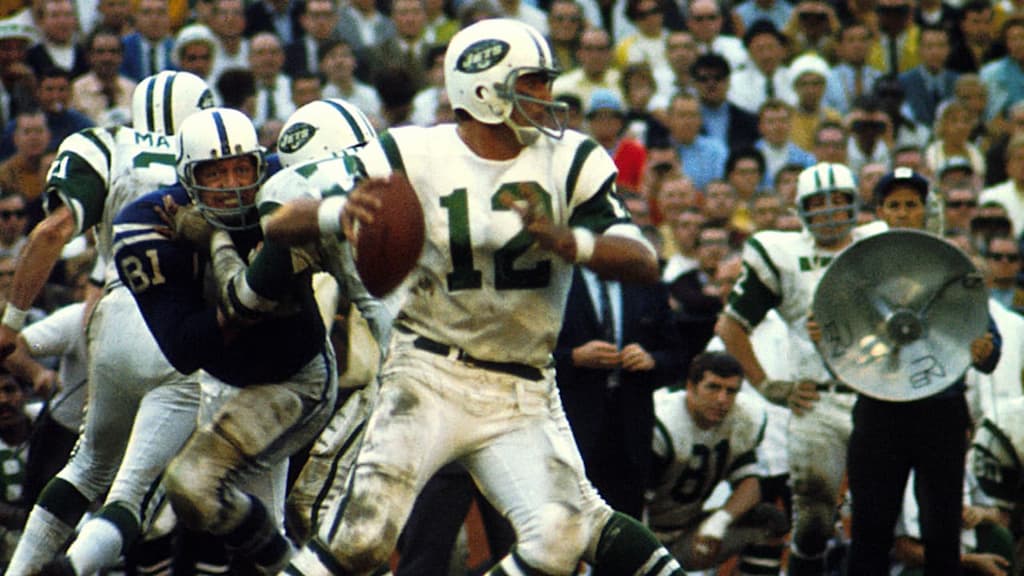
The New York Jets were established in 1960 as the Titans of New York and later adopted the Jets name in 1963. The franchise’s most defining moment came during the 1968 season, when quarterback Joe Namath led New York to a win in Super Bowl III. His pregame victory guarantee and the upset over the Baltimore Colts helped validate the AFL’s competitiveness and remains one of the league’s most referenced historical moments.
Success has come in cycles since that championship season. The Jets have fielded strong defensive units, featured standout offensive talent, and made multiple playoff pushes, including AFC Championship Game appearances in 1982, 1998, 2009, and 2010.
Other stretches have involved rebuilding periods and roster reshaping, a pattern familiar to long-time followers of the team.
Despite challenges, fan support has remained consistent, and the franchise continues to work toward sustained postseason presence. The Jets’ history is built on resilience, notable individual careers, and the hope of returning to championship contention in the years ahead.
Where Do the New York Jets Play?
The New York Jets play at MetLife Stadium in East Rutherford, New Jersey, a shared venue with the New York Giants. The stadium opened in 2010 with a capacity of more than 82,000 and is known for open-air conditions that can produce swirling winds late in the season.
For the Jets, the stadium provides a high-energy home atmosphere backed by one of the NFL’s most passionate fan bases.
Outside of football, MetLife Stadium is one of the most popular venues in the U.S. for major soccer matches. It hosted the final of the Copa America Centenario in 2016 and the final of the 2025 FIFA Club World Cup and has been selected as the venue for the final of the 2026 FIFA World Cup.
History of the New York Jets
Founded in 1960 as an AFL franchise, the team began as the Titans of New York before undergoing rebranding in 1963. The Jets quickly rose to prominence under head coach Weeb Ewbank, who assembled a balanced roster featuring Joe Namath and a powerful defense.
The Jets reached the peak of their success in the 1968 season by producing one of the biggest upsets in Super Bowl history. Namath’s guarantee before the Jets’ 16-7 win in Super Bowl III remains one of the most retold stories in league history. The victory over the highly-favored Colts proved that AFL teams could compete with and defeat established NFL powerhouses.
Following their championship era, the team went through cycles of rebuilds and playoff pushes. The late 1990s and early 2000s brought renewed relevance with Bill Parcells and later Rex Ryan. Each led the team to deep postseason runs, including consecutive AFC Championship Game appearances under Ryan in 2009 (a loss to the Colts) and 2010 (a loss to the Pittsburgh Steelers).
The franchise has continued building through draft talent and roster development in recent years, working to establish long-term stability and return to consistent postseason success.
Interesting New York Jets Facts & Franchise Milestones
- Founded in 1960 as the Titans of New York
- Renamed the New York Jets in 1963
- Upset the Baltimore Colts in Super Bowl III, a game known for Joe Namath’s pregame victory guarantee
- MetLife Stadium, which they share with the Giants, opened in 2010
- Known for one of the NFL’s most passionate fan bases
Notable New York Jets Players & Coaches
Notable Players
Don Maynard, Wide Receiver (1960–1972)
Don Maynard was a reliable deep threat and a key part of the Jets’ offense during their Super Bowl III season. He retired with over 11,000 receiving yards and remains one of the franchise’s all-time great receivers.
Joe Namath, Quarterback (1965–1976)
Namath was a Hall of Fame quarterback whose pregame guarantee and victory in Super Bowl III defined the franchise. He threw for more than 27,000 yards during his career with the Jets and became a cultural icon in the process.
Joe Klecko, Defensive Lineman (1977–1987)
Klecko was a dominant defender who played multiple positions along the defensive line. He earned Pro Bowl recognition four times for his versatility and was a cornerstone of the Jets’ defense during his tenure.
Mark Gastineau, Defensive End (1979–1988)
Gastineau was a key member of the Sack Exchange and one of the league’s top pass rushers in the early 1980s. He set the single-season sack record in 1983 and helped make New York’s defensive line one of the most feared units in football.
Wayne Chrebet, Wide Receiver (1995–2005)
Chrebet was a reliable possession receiver and fan favorite. He made key plays throughout his career and finished with 580 receptions, providing consistency in the Jets’ passing game.
Kevin Mawae, Center (1998–2005)
Mawae anchored the Jets’ offensive line and a respected team leader. He earned eight Pro Bowl selections and a place in Canton in 2019, deserved recognition for one of the top offensive linemen in the 2000s.
Curtis Martin, Running Back (1998–2006)
Curtis Martin, a consistent and productive back, finished his career among the NFL’s all-time leading rushers. He was known for his durability, vision, and ability to contribute in both the running and passing game.
Darrelle Revis, Cornerback (2007–2012, 2015–2016)
“Revis Island” was an elite shutdown cornerback whose coverage skills frustrated top receivers on a frequent basis. He was a critical contributor to the Jets’ deep playoff runs under head coach Rex Ryan.
Notable New York Jets Players and Coaches
Notable Coaches
Weeb Ewbank (1963–1973)
Weeb Ewbank guided the Jets to their first and, to date, only Super Bowl title. Notably, it came against the Colts, who he coached from 1954-62 and led to two NFL championships. Ewbank built balanced teams that were strong on both offense and defense and emphasized disciplined, well-executed football.
Bill Parcells (1997–1999)
Parcells rebuilt the Jets into a playoff contender and led the team to the AFC Championship Game in 1998. His tenure established a foundation for future competitiveness through strong leadership and roster construction.
Rex Ryan (2009–2014)
Rex Ryan was known for creating a defensive identity and leading the team with energy and intensity. He guided the Jets to back-to-back AFC Championship Game appearances in 2009 and 2010.