The Minnesota Vikings joined the NFL in 1961 and quickly grew into one of the league’s most respected franchises, recognized for physical football, defensive excellence, and a dedicated Midwestern fan base.
The team’s identity formed early through blue-collar toughness and top-tier coaching, securing frequent playoff appearances and trips to the game’s biggest stages.
Although the Vikings are still working toward their first Super Bowl championship, their history includes dominant eras, Hall of Famer–filled rosters, unforgettable postseason moments, and an intense rivalry with the Green Bay Packers.
Few teams have woven a history as dramatic as Minnesota’s. The infamous NFC Championship heartbreaks, miracle finishes, and generational stars have shaped a franchise that’s defined not only by talent, but by perseverance.
Despite the many heartbreaks and hard times, Vikings fans continue to pack the stadium in purple and gold, hopeful that the next great roster will be the one that finally breaks through with a Lombardi Trophy.
Where Do the Minnesota Vikings Play?
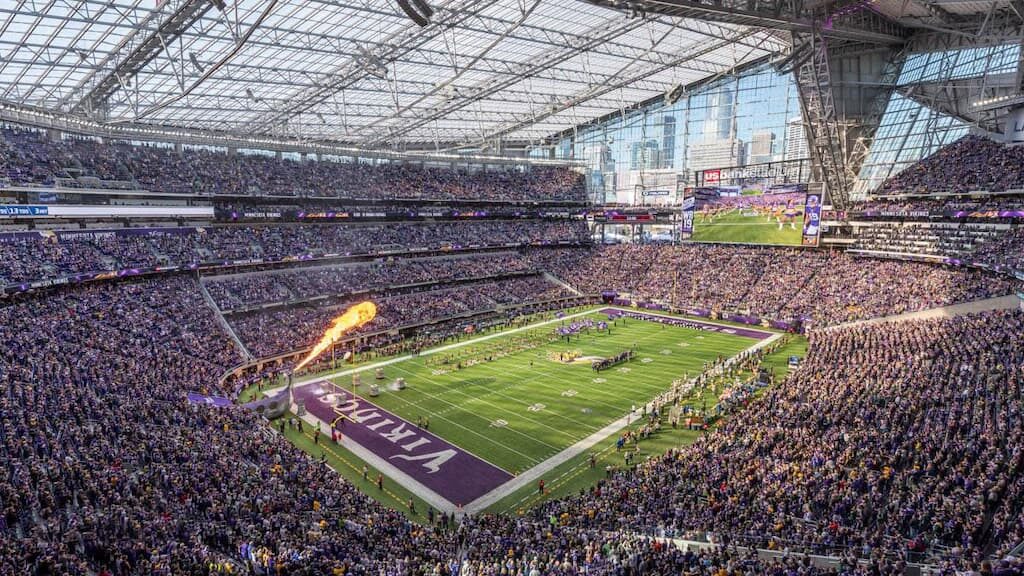
The Vikings play their home games at U.S. Bank Stadium in Minneapolis, Minnesota, a modern indoor venue known for noise levels that rattle opponents.
Opened in 2016, the stadium features a translucent roof that brings natural light indoors, sharp architectural lines, and one of the most electric home atmospheres in the NFL.
The venue hosted Super Bowl LII, multiple playoff games, and large-scale sporting and entertainment events, helping establish Minneapolis as a premier football destination. For Vikings fans, U.S. Bank Stadium represents both a home-field advantage and a reminder that a new era of football is underway.
History of the Minnesota Vikings
Established in 1961, the Vikings entered the NFL as an expansion franchise. Success arrived sooner than expected. Under head coach Bud Grant, Minnesota became one of football’s most dangerous teams during the late 1960s and 1970s.
The infamous Purple People Eaters defensive front, anchored by Alan Page, Carl Eller, Jim Marshall, and Gary Larsen, terrorized offenses with relentless pressure and discipline. The Vikings reached four Super Bowls (IV, VIII, IX, XI) during that span but came up short in each game against the Kansas City Chiefs, Miami Dolphins, Pittsburgh Steelers, and Oakland Raiders.
The franchise continued strong play into the 1980s and early 1990s, producing competitive teams and standout defenders.
However, a new chapter formed in the late 1990s when the offense exploded. Rookie Randy Moss, paired with Cris Carter and quarterback Randall Cunningham, turned Minnesota into a scoring machine during the 1998 season.
That team finished 15–1, shattered offensive records, and remains one of the most memorable squads in league history. However, that season ended in crushing fashion, as they were upset in the NFC Championship Game by the Atlanta Falcons.
In the 2000s and 2010s, the Vikings built contenders around star running back Adrian Peterson, whose violent running style and breakaway ability made him one of the most feared players of his era. Peterson’s 2012 season, during which he rushed for over 2,000 yards and won NFL MVP, stands as one of football’s greatest individual campaigns.
More recently, the franchise has blended aggressive roster building with a talent-rich core.
Interesting Facts & Franchise Milestones
- Founded in 1961
- Four Super Bowl appearances (IV, VIII, IX, XI)
- Purple People Eaters defense defined the 1970s
- Adrian Peterson won NFL MVP in 2012
- U.S. Bank Stadium opened in 2016 and hosted Super Bowl LII
- Known for intense home-field advantage and strong fan culture
Notable Minnesota Vikings Players
Fran Tarkenton, Quarterback (1961–1966, 1972–1978)
One of the NFL’s original mobile quarterbacks, Tarkenton revolutionized play with scrambles and improvisation. He retired as the league’s all-time leader in passing yards and touchdowns and led Minnesota to three Super Bowl appearances.
Carl Eller, Defensive End (1964–1978)
A six-time Pro Bowler and a member of the Hall of Fame, Eller’s length and strength made him a nightmare for offensive tackles. Eller recorded 10 or more sacks seven times, including five straight from 1973 to 1977.
Alan Page, Defensive Tackle (1967–1978)
Considered one of the greatest defensive players in NFL history, Alan Page was a dominant interior lineman for more than a decade. In 1971, Page became the first defensive player to be named NFL MVP. As of 2025, only one other player (former New York Giants star Lawrence Taylor, who won it in 1986).
Page, who earned Pro Bowl honors in nine consecutive seasons from 1968 to 1976, became a lawyer after the end of his football career. He later became the first African-American member of the Minnesota Supreme Court, serving for more than two decades before his retirement.
Cris Carter, Wide Receiver (1990–2001)
“All he does is catch touchdowns” became reality. Carter recorded 1,000+ receptions while with the Vikings, and his lethal pairing with Moss was a big part of why Minnesota went 36-12 from 1998 to 2000.
John Randle, Defensive Tackle (1990–2000)
Undrafted and undersized for his position but unforgettable, John Randle used quickness and motor to rack up sacks and become a fan favorite. He recorded double-digit sacks eight times in his 11 seasons in Minnesota, received six Pro Bowl nods while with the Vikings, and earned his bust in Canton in 2010.
Randy Moss, Wide Receiver (1998–2004, 2010)
A generational receiver whose speed and leaping ability changed how defenses were built. Moss remains one of the most electrifying players in recent memory. He also courted a wealth of attention beyond his memorable exploits on the field.
Adrian Peterson, Running Back (2007–2016)
A power-speed combination few could match. Peterson rushed for over 2,000 yards in 2012, won MVP, and ranks among the top running backs of all time.
Harrison Smith, Safety (2012–present)
Smart, physical, and versatile, Smith remains a leader of the Vikings’ secondary. A first-round pick out of Notre Dame in 2012, Smith has earned several Pro Bowl selections in his NFL career.
Notable Coaches
Bud Grant (1967–1983, 1985)
Bud Grant led the Vikings to four Super Bowl appearances and built a culture based on discipline and execution.
Dennis Green (1992–2001)
Green produced consistent playoff contenders, including the record-setting 1998 team. In his ten seasons in Minnesota, the Vikings went to the playoffs eight times and won four NFC Central titles, an impressive feat given the success that the rival Packers had in the same period.
Mike Zimmer (2014–2021)
Zimmer restored defensive toughness and helped guide the Vikings to multiple postseason runs. He led Minnesota to three playoff appearances, two NFC North titles, and an NFC Championship Game appearance in the 2017 season.