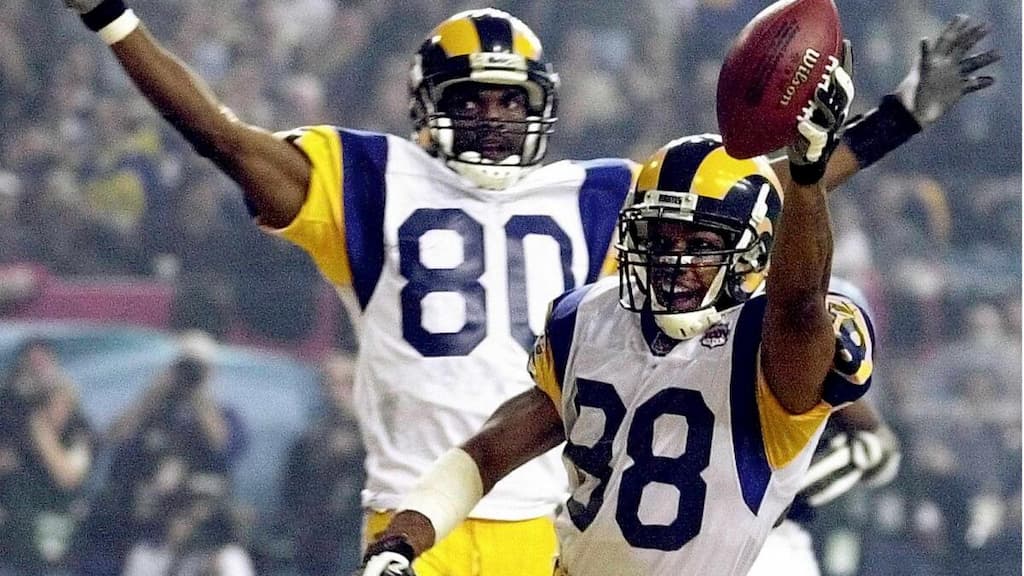
The Los Angeles Rams hold one of the NFL’s longest and most eventful histories. The franchise has changed cities, built iconic rosters, and produced championship teams across generations. Each move and era brought a new identity, yet the Rams have contended for titles at some point in almost all of their decades in the NFL.
The team began in 1936 in Cleveland, then shifted to Los Angeles in 1946, becoming the first major professional sports franchise on the West Coast. They later moved to St. Louis in 1995, where they won their first Super Bowl. After returning to Los Angeles in 2016, the Rams entered another successful chapter driven by star power and modern coaching.
Over time, the franchise has delivered multiple defining eras. The Fearsome Foursome dominated the 1960s with intimidating defense. The Greatest Show on Turf lit up the league in the early 2000s with explosive passing and speed. More recently, the Sean McVay era restored the Rams to the top of the NFL and produced another Lombardi Trophy. Few organizations have evolved as often or as successfully.
Where Do the Los Angeles Rams Play?
The Rams play at SoFi Stadium in Inglewood, California, a venue shared with the Los Angeles Chargers. Opened in 2020, it stands out for its panoramic design, premium seating, and massive dual-sided video board. The stadium holds more than 70,000 fans and offers one of the most modern gameday experiences in professional sports.
SoFi quickly became a showcase venue. It hosted Super Bowl LVI, major concerts, college championships, and global events. As a result, the stadium symbolizes the Rams’ return to Los Angeles and anchors the franchise’s current era.
History of the Los Angeles Rams
The Rams began in Cleveland in 1936 and moved to Los Angeles ten years later. That relocation helped expand the NFL’s footprint and made the Rams early innovators in the passing game. The 1960s brought the Fearsome Foursome, a defensive front that helped define toughness and physical play across the league.
The franchise later moved to St. Louis in 1995. Soon after, the late 1990s and early 2000s produced The Greatest Show on Turf, led by Kurt Warner, Marshall Faulk, Isaac Bruce, and Torry Holt. Their fast-paced offense changed how teams approached scoring and led to a victory over the Tennessee Titans in Super Bowl XXXIV.
In 2016, the Rams returned to Los Angeles. Four years later, head coach Sean McVay guided the team to Super Bowl LVI, powered by stars like Aaron Donald, Matthew Stafford, and Cooper Kupp. The Rams’ thrilling win over the Cincinnati Bengals made them the second straight team to win the Super Bowl in their home stadium, following the Tampa Bay Buccaneers‘ win over the Kansas City Chiefs in Super Bowl LV.
Across nearly 90 years, the Rams have mirrored the league’s evolution. They have showcased dominant defenses, revolutionary offenses, and multiple championship-caliber cores, helping to shape the story of the NFL in different ways.
Interesting Facts & Franchise Milestones
- Founded in 1936 (Cleveland) → moved to Los Angeles in 1946 → to St. Louis in 1995 → returned to L.A. in 2016
- Super Bowl Champions: XXXIV (St. Louis) and LVI (Los Angeles)
- Home of the Fearsome Foursome defense in the 1960s
- Greatest Show on Turf transformed passing attacks in the early 2000s
- SoFi Stadium opened in 2020 and hosted Super Bowl LVI
Notable Los Angeles Rams Players and Coaches
Notable Players
Deacon Jones, Defensive End (1961–1971)
Deacon Jones helped coin the term sack and became one of the first true pass-rush stars. His mix of speed and power made him a cornerstone of Los Angeles defense and left a legacy that shaped modern edge rushing.
Merlin Olsen, Defensive Tackle (1962–1976)
Olsen anchored the interior of the Fearsome Foursome and appeared in 14 Pro Bowls, setting a standard for durability and elite play. His technique and strength made him one of the most complete defensive linemen of his era.
Jack Youngblood, Defensive End (1971–1984)
Youngblood was known for intensity and resilience. He earned seven Pro Bowl selections, played through injuries, and represented the type of grit the Rams became known for in the 1970s.
Jackie Slater, Offensive Tackle (1976–1995)
Slater spent 20 seasons with the Rams, displaying nearly unmatched longevity at his position. He earned seven Pro Bowl honors and protected quarterbacks across four different decades.
Eric Dickerson, Running Back (1983–1987)
Dickerson’s upright running style and breakaway speed defined 1980s football. He set the single-season rushing record in 1984 with 2,105 yards, a mark that still stands. His time with the Rams was relatively short compared to other legendary franchise figures, but he ran for 1,800+ yards three times in his four full seasons in Los Angeles. Dickerson remains one of the NFL’s most electrifying runners.
Isaac Bruce, Wide Receiver (1994–2007)
Bruce delivered precision routes and dependable production. He recorded more than 15,000 receiving yards in his career and caught the game-winning touchdown in Super Bowl XXXIV.
Orlando Pace, Offensive Tackle (1997-2008)
Pace was selected with the first overall pick of the 1997 NFL Draft, and he repaid that investment several times over, becoming one of the best offensive linemen of his generation. He earned seven Pro Bowl selections in his 12 seasons in St. Louis and received his bust in Canton in 2016.
Marshall Faulk, Running Back (1999–2005)
Faulk combined elite rushing with receiver-like versatility. He won NFL MVP in 2000, helped fuel the Greatest Show on Turf, and created matchup nightmares for defenses.
Kurt Warner, Quarterback (1998–2003)
Warner rose from unknown backup to two-time league MVP with the Rams. His accuracy and leadership guided St. Louis to a title in Super Bowl XXXIV and one of the most exciting offenses ever.
Torry Holt, Wide Receiver (1999–2008)
Torry Holt quickly formed one of the NFL’s most dangerous duos with Isaac Bruce after entering the league in the Rams’ Super Bowl-winning season in 1999. From 2000 to 2007, he posted eight straight 1,000-yard seasons and led the NFL in receiving yards twice. His speed and separation ability kept defenses off balance for years.
Aaron Donald, Defensive Tackle (2014–2023)
In his 10-season NFL career, Donald was one of the most dominant defenders in modern football. Donald’s peak coincided with the Rams’ return to Los Angeles, as he earned NFL Defensive Player of the Year honors three times (2017, 2018, 2020). His presence demanded constant double-teams, which often proved ineffective.
Cooper Kupp, Wide Receiver (2017–2024)
Kupp became a focal point of McVay’s offense and delivered a historic Triple Crown season in 2021, when he caught 145 passes for 1,947 yards and 16 touchdowns to lead the NFL in all three categories. He rounded out that season by catching the championship-clinching touchdown and earning Super Bowl LVI MVP honors, cementing his place alongside other franchise heroes.
Notable Coaches
George Allen (1966–1970)
Allen built playoff-level consistency through discipline and defensive emphasis. His teams reached the postseason four times, helping elevate the franchise in the late 1960s.
Chuck Knox (1973–1977, 1992–1994)
Knox earned the nickname “Ground Chuck” for his power-running style. He guided the Rams to five consecutive NFC West titles in his first stint with the franchise, as well as three NFC Championship Game losses, two to the Minnesota Vikings and one to the Dallas Cowboys.
John Robinson (1983–1991)
Robinson was never able to lead the Rams to a Super Bowl appearance, but his teams were consistently successful. In his nine seasons in Los Angeles, the Rams made six playoff appearances, won 75 games, and reached the NFC Championship Game twice.
Dick Vermeil (1997–1999)
Vermeil oversaw one of the sport’s greatest turnarounds, leading the Rams to a Super Bowl XXXIV win. His emotional leadership and detail-driven approach set the stage for an all-time offense.
Mike Martz (2000–2005)
Martz carried the high-fly offense into the 2000s. Under him, St. Louis returned to the Super Bowl and maintained elite scoring with creative passing and pace.
Sean McVay (2017–present)
McVay arrived at age 30 and immediately rebuilt the Rams as they settled back to life in Los Angeles. He led Los Angeles to two Super Bowl appearances and a championship in Super Bowl LVI, becoming one of today’s top offensive minds.