The Detroit Lions stand as one of the NFL’s oldest and most tradition-rich franchises. Founded in 1930 as the Portsmouth Spartans before relocating to Detroit in 1934, the team has remained a fixture of the league’s history for nearly a century.
Known for loyal fan support, iconic Thanksgiving Day games, and memorable stars, the Lions have forged a legacy defined by perseverance and deep ties to the city of Detroit.
Generations of NFL fans have supported the Lions through ups, downs, and moments that have shaped the franchise’s identity. From early championship success to modern efforts to rebuild a competitive roster, the Lions have long been emblematic of Detroit’s grit, resilience, and enduring pride.
Today, the Detroit Lions are focused on building a new era of success. With strong coaching, a passionate fanbase, and a foundation of young talent, the team continues working toward sustained playoff contention and a brighter future.
Where Do the Detroit Lions Play?
The Detroit Lions play their home games at Ford Field, which is an indoor stadium located in the heart of downtown Detroit. Opened in 2002, Ford Field seats roughly 65,000 fans and provides a modern, climate-controlled environment ideal for fast-paced football.
The stadium features excellent sightlines, upgraded fan amenities, and an architectural design that incorporates elements of a historic Hudson’s Warehouse into its structure. Ford Field regularly hosts major events such as college football games, concerts, and conventions in addition to Lions home games.
Detroit’s indoor setting ensures consistent playing conditions, offering an advantage for precision offense and helping create a loud, energetic atmosphere driven by one of the NFL’s most passionate fanbases.
History of the Detroit Lions
The Detroit Lions’ history dates back to 1930, when the team was established as the Portsmouth Spartans. After financial pressures led to relocation in 1934, the newly named Detroit Lions quickly found success, capturing the NFL championship that same year.
The Lions’ golden era arrived in the 1950s. Led by quarterback Bobby Layne, running back Doak Walker, and a tough, well-coached roster, Detroit won three NFL championships in 1952, 1953, and 1957.
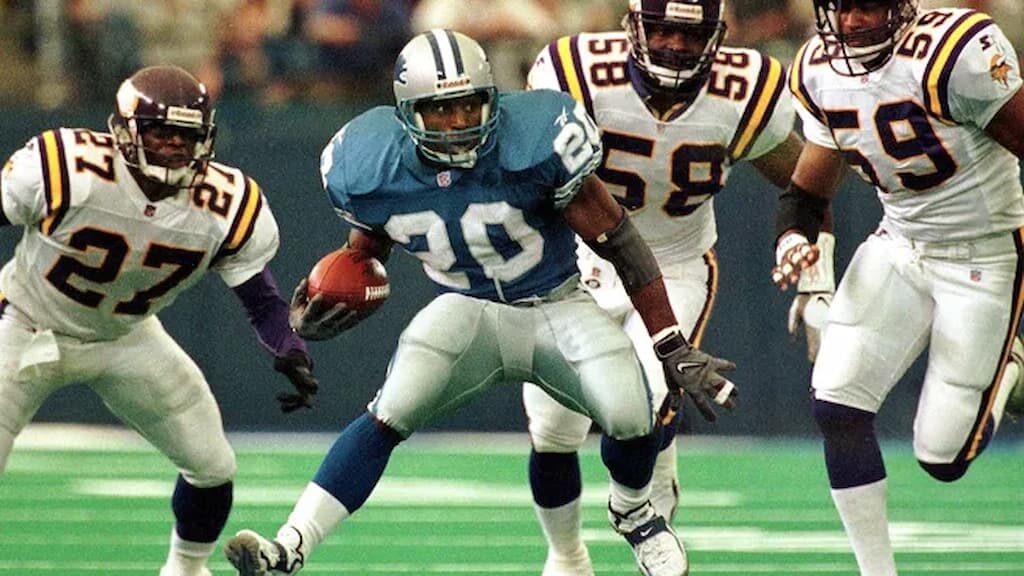
In later decades, Detroit continued producing iconic individual performers despite mixed team results. The 1980s and 1990s were defined by Barry Sanders, one of the greatest running backs in NFL history. Sanders’ electrifying style, unmatched agility, and consistent production made him the centerpiece of the franchise and a beloved figure across the league. Under head coach Wayne Fontes, Sanders and the Lions reached the NFC Championship Game in the 1991 season.
Rebuilding efforts marked the 2000s and 2010s. Quarterback Matthew Stafford emerged, and his favorite target was dominant wide receiver Calvin Johnson. Johnson, known as “Megatron,” became one of the most unstoppable receivers of all time, setting the NFL single-season receiving yards record in 2012.
A new era of optimism has emerged in the 2020s. Under head coach Dan Campbell, Detroit has reestablished its identity through toughness, physical play, and strong drafting. After years of transition, the Lions have regained national relevance and renewed confidence among their fanbase.
Interesting Facts & Franchise Milestones for the Detroit Lions
- Established in 1930 as the Portsmouth Spartans before relocating to Detroit in 1934.
- Won four pre–Super Bowl NFL championships: 1935, 1952, 1953, and 1957.
- Host the annual Thanksgiving Day game, a tradition that began in 1934.
- Barry Sanders rushed for over 1,000 yards in each of his 10 seasons and retired with 15,269 yards.
- Calvin Johnson set the NFL single-season receiving yards record with 1,964 in 2012.
- Ford Field incorporates historic warehouse architecture, creating one of the league’s most distinctive indoor stadium designs.
Notable Detroit Lions Players and Coaches
Notable Players
Bobby Layne, Quarterback (1950–1958)
Bobby Layne led Detroit through its championship-filled 1950s era. A tough, competitive passer and field general, Layne helped the Lions capture three NFL titles and became one of the most influential players in franchise history.
Doak Walker, Running Back (1950–1955)
Doak Walker was a versatile star during Detroit’s golden years, contributing as a rusher, receiver, and kicker. A two-time NFL champion and Hall of Famer, Walker remains one of the franchise’s most celebrated early-era players.
Barry Sanders, Running Back (1989–1998)
Barry Sanders is widely regarded as one of the greatest running backs in NFL history. Known for unmatched agility, elusiveness, and balance, he recorded 15,269 rushing yards and 99 touchdowns over 10 seasons. Sanders earned the 1997 NFL MVP award and remains the face of the modern era for the Detroit Lions.
Calvin Johnson, Wide Receiver (2007–2015)
Calvin “Megatron” Johnson redefined the wide receiver position with his combination of size, speed, and athleticism. A six-time Pro Bowler, Johnson tallied 11,619 receiving yards and set the single-season record with 1,964 in 2012. His dominance made him one of the most feared pass catchers of all time.
Matthew Stafford, Quarterback (2009–2020)
Matthew Stafford, the first overall pick in the 2009 NFL Draft, became the centerpiece of the Lions’ offense for more than a decade. With strong arm talent and numerous comeback victories, he set multiple franchise passing records and helped guide Detroit to several playoff appearances in the 2010s.
Notable Coaches
Buddy Parker (1951–1956)
Buddy Parker played a central role in shaping the franchise’s golden era. He led the Lions to NFL championships in 1952 and 1953 and another championship game appearance in 1954. His disciplined teams and strong strategic approach established Detroit as one of the league’s top organizations of the time.
Wayne Fontes (1988–1996)
Wayne Fontes guided the Lions through their most successful stretch of the modern era, including a 1991 run to the NFC Championship Game. Popular among players and known for his leadership through fluctuating seasons, Fontes remains a memorable figure in team history.
Dan Campbell (2021–Present)
Dan Campbell has brought renewed energy and identity to the Lions. Known for his motivational leadership and aggressive style of play, he helped guide Detroit back into playoff contention and reestablished a strong culture built on effort, toughness, and player development.